High Voltage&Low Voltage Switchgear Cabinets Manufacturing Company. more than 17 years design and RD experience.


-
Leave a Message : qiuwenjie@gaoboele.com
-
Phone : +86 -17329948916

Leave a Message : qiuwenjie@gaoboele.com
Phone : +86 -17329948916

Choosing the right switchgear is a critical step in designing a safe and reliable factory power distribution system. Manufacturing plants rely on continuous electricity for production lines, motors, compressors, pumps, HVAC systems, automation equipment, lighting, and auxiliary services. If the switchgear is incorrectly selected, the result may be unnecessary shutdowns, difficult maintenance, insufficient protection, or limited expansion capacity.
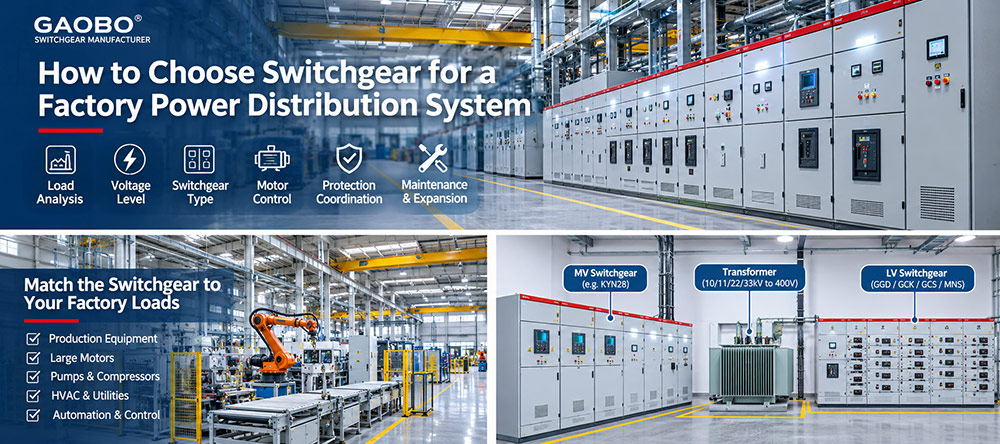
For factory owners, EPC contractors, electrical engineers, and system integrators, switchgear selection should consider more than rated voltage and current. The complete electrical architecture, load profile, short-circuit level, motor quantity, operating environment, maintenance strategy, and future expansion plan should all be reviewed.
GAOBO SWITCHGEAR MANUFACTURER provides customized high-voltage, medium-voltage, and low-voltage switchgear for industrial power distribution projects.
The first step is understanding the actual electrical load.
Factories may include different types of loads such as:
Large motors
Production machinery
Pumps and fans
Compressors
Welding equipment
HVAC systems
Lighting
PLC and automation equipment
Office and auxiliary loads
The total connected load is important, but engineers should also consider demand factor, simultaneous operation, motor starting current, peak demand, and future expansion.
A clear load schedule helps determine transformer capacity, incoming feeder size, busbar rating, and switchgear configuration.
The correct switchgear depends heavily on the utility supply voltage.
A factory may receive power at:
10kV
11kV
22kV
33kV
Other regional voltage levels
Medium-voltage switchgear is typically installed on the incoming side of the transformer.
For example, a factory receiving 11kV utility power may use KYN28 metal-clad switchgear for incoming and transformer feeder circuits, then step the voltage down to 400V for low-voltage distribution.
The project should always confirm the utility connection conditions before finalizing switchgear selection.
After the transformer, low-voltage switchgear distributes power to factory equipment.
Different cabinet types serve different purposes.
GGD fixed switchgear is suitable for general distribution where simple structure and cost control are important.
GCK and GCS withdrawable switchgear are better suited to projects requiring modular feeders and easier maintenance.
MNS switchgear is commonly selected for more demanding industrial applications where high modularity, internal separation, and future expansion are priorities.
The best cabinet type depends on the factory's operating and maintenance strategy.
Factories often contain many motors.
Motor circuits may require:
Circuit breakers
Contactors
Overload protection
Soft starters
Variable-frequency drives
PLC interfaces
Local and remote control
Communication functions
For motor-intensive facilities, a dedicated Motor Control Center (MCC) may be more efficient than using standard feeder cabinets.
GAOBO can integrate MCC functions with PLC control systems and VFDs according to the production process.
Short-circuit performance is one of the most important technical parameters.
The switchgear must be able to withstand and interrupt the maximum fault current at the installation point.
Engineers should confirm:
Short-time withstand current
Peak withstand current
Breaker interrupting capacity
Busbar strength
Protection coordination
Selecting switchgear with insufficient fault capacity creates a serious safety risk.
The short-circuit level should be calculated before final equipment selection.
A good factory distribution system should isolate only the faulty section whenever possible.
Protection coordination may involve:
Incoming circuit breakers
Transformer protection
Bus couplers
Outgoing feeders
Motor protection
Earth-fault protection
Overcurrent protection
Correct coordination helps prevent a small downstream fault from shutting down the entire factory.
For production facilities where downtime is expensive, selective protection is particularly important.
Maintenance strategy should influence switchgear design.
Fixed-type cabinets are generally simpler and more economical, but maintenance may require longer shutdown periods.
Withdrawable systems allow individual feeder units to be removed or replaced more easily.
Factories operating 24 hours a day may benefit from modular switchgear that reduces maintenance interruption.
Project teams should consider:
Spare feeder availability
Drawer interchangeability
Access clearance
Cable compartment access
Maintenance frequency
Shutdown tolerance
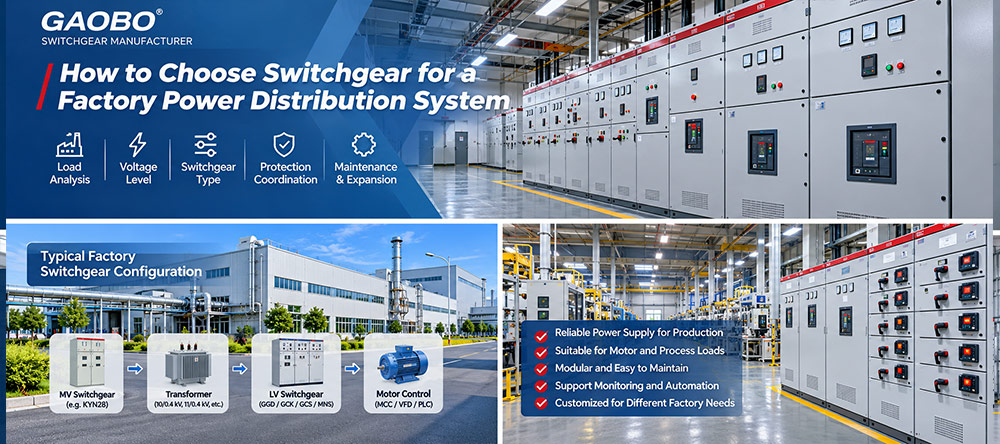
Industrial environments can be very different from commercial buildings.
A factory may have:
Dust
Humidity
High temperature
Chemical contamination
Vibration
Corrosive conditions
The switchgear enclosure should be designed accordingly.
Important considerations include IP protection level, ventilation, cooling, anti-corrosion treatment, cabinet sealing, and cable entry.
The wrong enclosure design can reduce equipment life even if the electrical ratings are correct.
Modern factories increasingly use intelligent power monitoring.
Switchgear can be integrated with:
Digital meters
Smart protection relays
Temperature monitoring
PLC systems
HMI screens
SCADA
Energy-management systems
Remote alarms
These functions allow operators to track load, energy consumption, breaker status, alarms, and selected equipment conditions.
For smart factories, this information can support preventive maintenance and better energy management.
Factories rarely remain unchanged.
New production lines, motors, automation systems, and equipment may increase electrical demand.
When selecting switchgear, consider:
Spare feeder space
Extra busbar capacity
Future transformer capacity
Cabinet extension possibilities
Additional communication points
A slightly larger initial design may reduce the cost of future expansion.
GAOBO SWITCHGEAR MANUFACTURER can provide customized solutions including:
Medium-voltage switchgear
KYN28 cabinets
GGD fixed switchgear
GCK withdrawable switchgear
GCS switchgear
MNS systems
MCC cabinets
PLC control cabinets
ATS cabinets
Capacitor compensation cabinets
Customers can provide single-line diagrams, load schedules, motor lists, preferred component brands, and installation conditions for engineering review.
Selecting switchgear for a factory power distribution system requires a complete understanding of load demand, incoming voltage, short-circuit level, motor control, protection coordination, maintenance, operating environment, and future expansion.
The best solution is not simply the lowest-cost cabinet. It is the system that supports safe operation, production continuity, easier maintenance, and long-term flexibility.
GAOBO SWITCHGEAR MANUFACTURER provides customized industrial switchgear solutions to help factories build safer, more efficient, and more reliable power distribution systems.
The best type depends on voltage level, load, motor quantity, maintenance requirements, and budget. Factories may use KYN28 for medium voltage and GGD, GCK, GCS, or MNS for low-voltage distribution.
Withdrawable switchgear is often useful in factories where fast maintenance and feeder replacement are important. However, fixed switchgear may be more cost-effective for simpler distribution systems.
Switchgear must safely withstand and interrupt fault current. Insufficient short-circuit capacity can create serious equipment and safety risks.
Yes. GAOBO SWITCHGEAR MANUFACTURER can integrate PLC systems, variable-frequency drives, motor control, communication, and HMI functions according to the production process.
Customers should provide the single-line diagram, load schedule, incoming voltage, rated current, short-circuit level, motor list, feeder quantity, preferred component brands, installation environment, and future expansion requirements.