High Voltage&Low Voltage Switchgear Cabinets Manufacturing Company. more than 17 years design and RD experience.


-
Leave a Message : qiuwenjie@gaoboele.com
-
Phone : +86 -17329948916

Leave a Message : qiuwenjie@gaoboele.com
Phone : +86 -17329948916

As electric vehicle charging infrastructure expands, EV charging stations are becoming a significant new type of electrical load. Large charging hubs may include dozens of AC chargers, high-power DC fast chargers, battery energy storage systems, lighting, monitoring equipment, and auxiliary services. These loads require a properly designed power distribution system to ensure safety, reliability, and future expansion.
For project owners, EPC contractors, charging network operators, and electrical engineers, selecting the right switchgear is essential. The required equipment depends on charger capacity, utility connection voltage, transformer size, redundancy requirements, and site layout.
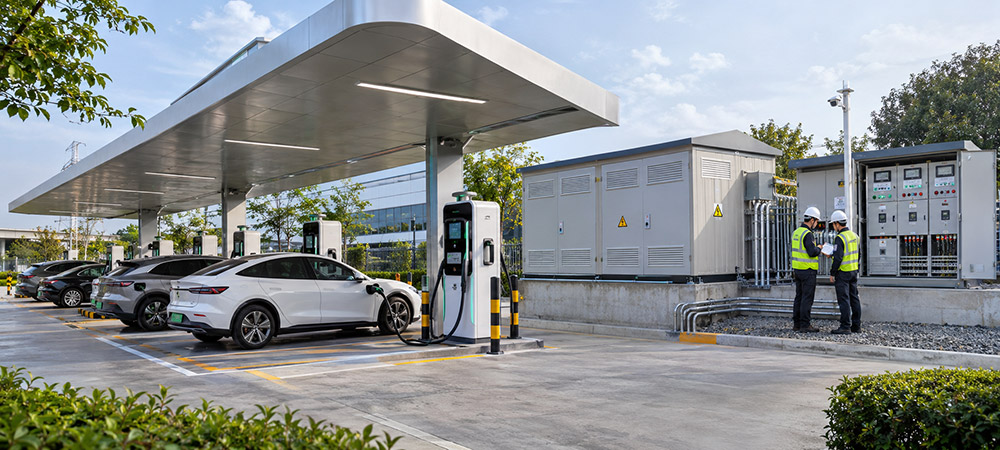
GAOBO SWITCHGEAR MANUFACTURER provides customized medium-voltage and low-voltage switchgear solutions for EV charging stations, commercial charging hubs, fleet depots, industrial parks, and other new-energy infrastructure projects.
Large EV charging stations may receive power directly from a medium-voltage utility network.
Depending on the region, the incoming voltage may be:
10kV
11kV
22kV
33kV
Medium-voltage switchgear is installed before the transformer and is responsible for receiving, switching, protecting, and isolating incoming utility power.
Typical equipment may include:
KYN28 metal-clad switchgear
Ring main units
Incoming feeder cabinets
Transformer protection cabinets
Metering cabinets
Bus-coupler panels
For compact urban charging stations, RMUs may be useful because they provide reliable medium-voltage switching in a relatively small footprint.
The utility voltage must normally be reduced before electricity can be supplied to EV chargers.
For example, an 11kV or 22kV incoming supply may be stepped down to 400V through a distribution transformer.
A box-type substation can be an efficient solution because it integrates:
Medium-voltage switchgear
Transformer
Low-voltage distribution
Protection
Metering
Auxiliary systems
Prefabricated box substations can reduce on-site installation work and are particularly suitable for charging stations, parking facilities, highway service areas, industrial parks, and fleet charging depots.
GAOBO can customize transformer capacity and MV/LV panel configuration according to charger quantity and total project load.
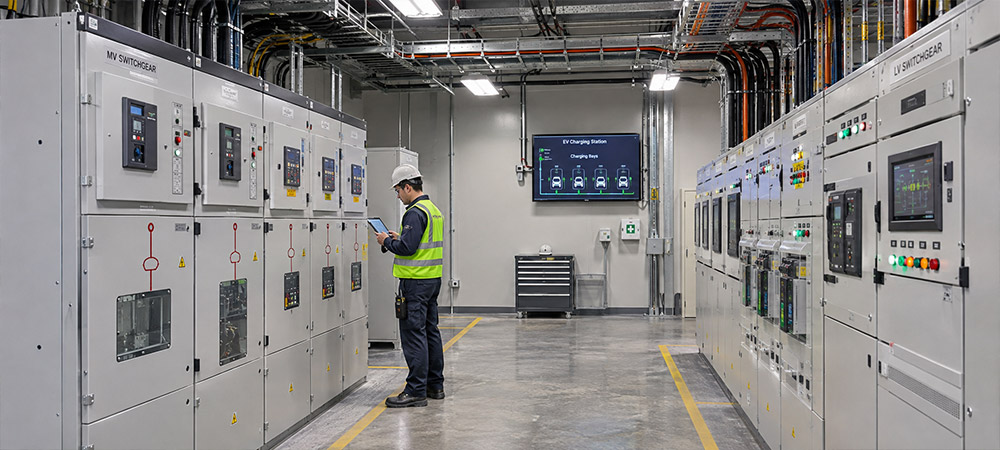
After the transformer, low-voltage switchgear distributes power to individual charger groups.
Common low-voltage cabinet types may include:
GGD fixed switchgear
GCK withdrawable switchgear
GCS switchgear
MNS switchgear
Main distribution boards
The correct cabinet type depends on project size and maintenance requirements.
For a smaller charging station, fixed switchgear may provide a practical and cost-effective solution.
For large charging hubs with many outgoing circuits, modular or withdrawable switchgear may provide easier feeder replacement and future expansion.
Each charger or group of chargers requires suitable protection.
The distribution system may include:
Air circuit breakers
Molded-case circuit breakers
Residual-current protection
Surge protection devices
Overcurrent protection
Short-circuit protection
Isolation devices
Protection settings should be coordinated so that a fault at one charger does not unnecessarily interrupt the entire charging station.
Selective protection is especially important for commercial charging hubs where downtime directly affects service availability.
Some charging facilities may require backup power for control systems, lighting, communication equipment, or critical chargers.
An Automatic Transfer Switch (ATS) cabinet can automatically switch between normal and standby power sources.
This may be useful where the site includes:
Backup generators
Dual utility supplies
Critical control systems
Emergency lighting
Monitoring equipment
Not every charging station needs full backup power for all chargers, but essential systems should be evaluated according to the operating strategy.
Large EV charging stations can create significant electrical demand.
Depending on the charger technology and site conditions, engineers may need to evaluate:
Power factor
Harmonics
Voltage fluctuation
Reactive power
Transformer loading
Low-voltage compensation cabinets, harmonic mitigation equipment, or power-quality monitoring may be included where required.
The exact solution should be based on electrical measurements and charger specifications rather than using a standard configuration for every site.
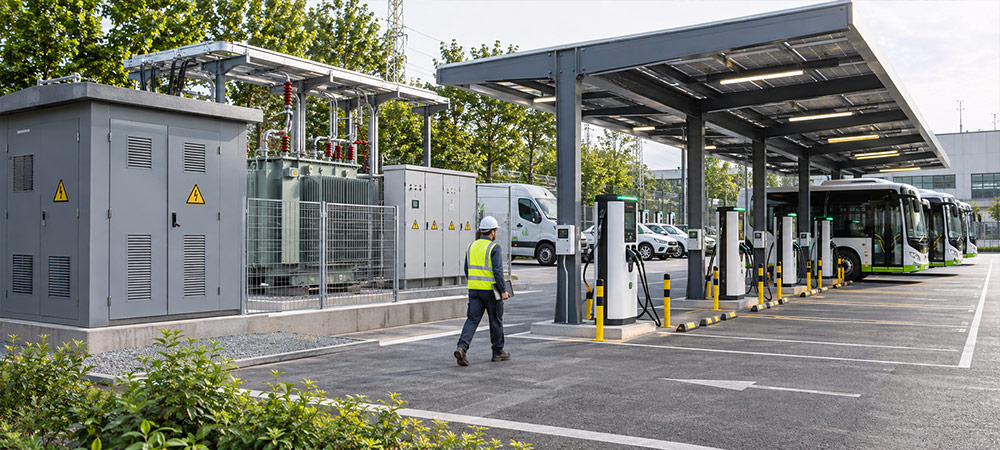
Modern EV charging stations increasingly require intelligent monitoring.
Switchgear can be integrated with:
Digital meters
Smart protection relays
PLC systems
HMI displays
Communication gateways
Remote monitoring
Energy-management systems
Operators can monitor voltage, current, power, energy consumption, breaker status, alarms, and feeder loading.
This data can help identify overloaded circuits, improve maintenance planning, and support energy management.
For charging stations combined with solar power or battery energy storage, intelligent monitoring becomes even more important.
EV charging demand can grow quickly.
A station that begins with 20 chargers may later require 40 or more.
Switchgear design should therefore consider:
Spare outgoing feeders
Extra busbar capacity
Transformer expansion
Additional cabinet space
Future battery storage
Solar integration
Higher-power chargers
Planning expansion during the initial design can reduce modification costs later.
GAOBO SWITCHGEAR MANUFACTURER can provide customized power distribution equipment for EV charging infrastructure, including:
Medium-voltage switchgear
KYN28 cabinets
Ring main units
Box-type substations
GGD low-voltage cabinets
GCK/GCS/MNS switchgear
ATS cabinets
PLC control cabinets
Capacitor compensation cabinets
Smart monitoring systems
Customers can provide single-line diagrams, charger quantity, charger power, utility voltage, transformer requirements, preferred component brands, and site conditions for engineering review.
An EV charging station requires more than chargers alone. A complete power distribution system may include medium-voltage switchgear, transformers, low-voltage distribution cabinets, protection devices, ATS systems, monitoring, and power-quality equipment.
The correct configuration depends on charger capacity, utility supply, redundancy, maintenance strategy, and future expansion.
GAOBO SWITCHGEAR MANUFACTURER provides customized switchgear and power distribution solutions to help EV charging projects achieve safer, more reliable, and more scalable operation.
No. Smaller stations may receive low-voltage utility power directly. Larger charging hubs with high total capacity often require a medium-voltage connection and dedicated transformer.
GGD may suit smaller projects, while GCK, GCS, or MNS systems may be better for larger stations requiring modular feeders, easier maintenance, and future expansion.
Yes. Box-type substations are well suited to EV charging because they can integrate medium-voltage switchgear, transformers, and low-voltage distribution in one prefabricated system.
Yes. Smart meters, communication systems, PLCs, and monitoring platforms can help operators track charger loads, alarms, breaker status, and energy consumption.
Yes. GAOBO SWITCHGEAR MANUFACTURER can customize MV and LV switchgear, box substations, ATS cabinets, monitoring systems, and protection configurations according to charger capacity and project requirements.