High Voltage&Low Voltage Switchgear Cabinets Manufacturing Company. more than 17 years design and RD experience.


-
Leave a Message : qiuwenjie@gaoboele.com
-
Phone : +86 -17329948916

Leave a Message : qiuwenjie@gaoboele.com
Phone : +86 -17329948916

Low voltage switchgear is widely used in factories, commercial buildings, data centers, water-treatment plants, infrastructure projects, and industrial power systems. Among the most common cabinet types are GCK, GCS, MNS, and GGD low voltage switchgear.
Although all four are used for low-voltage power distribution, they differ in structure, modularity, maintenance method, installation flexibility, and typical applications.
For EPC contractors, electrical engineers, system integrators, and project owners, understanding these differences can help avoid over-design, reduce project cost, and improve long-term maintenance.
GAOBO SWITCHGEAR MANUFACTURER provides customized GCK, GCS, MNS, GGD, and other low-voltage switchgear solutions for international industrial and commercial projects.
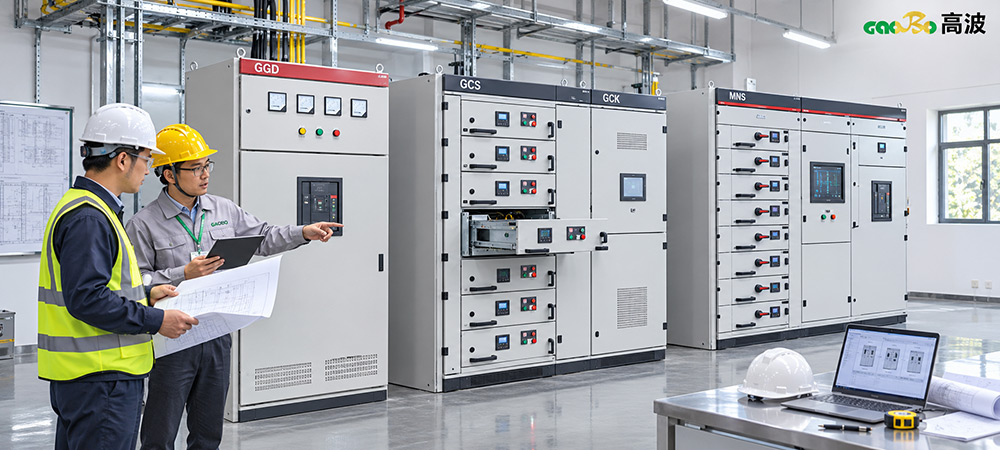
GGD is a fixed-type low-voltage distribution cabinet.
Its structure is relatively simple compared with drawer-type systems. Main components such as circuit breakers, meters, and protection devices are installed in fixed positions inside the cabinet.
GGD is commonly used for:
Incoming power distribution
Outgoing feeder circuits
General factory distribution
Commercial buildings
Public facilities
Transformer secondary distribution
The main advantages of GGD are simple structure, easier inspection, relatively low cost, and straightforward maintenance.
However, because the internal components are fixed, GGD is less flexible than withdrawable systems when rapid feeder replacement or frequent reconfiguration is required.
GCK is a withdrawable low-voltage switchgear system designed for both power distribution and motor control.
Its functional units are installed in drawers, allowing individual circuits to be withdrawn for maintenance or replacement.
GCK is commonly used in:
Manufacturing plants
Motor control centers
Industrial parks
Water-treatment plants
Rail projects
Large commercial facilities
The drawer structure makes maintenance more convenient because one functional unit can be removed without completely dismantling the cabinet.
GAOBO can customize GCK cabinets according to feeder quantity, rated current, breaker brands, motor-control requirements, metering, communication, and busbar capacity.
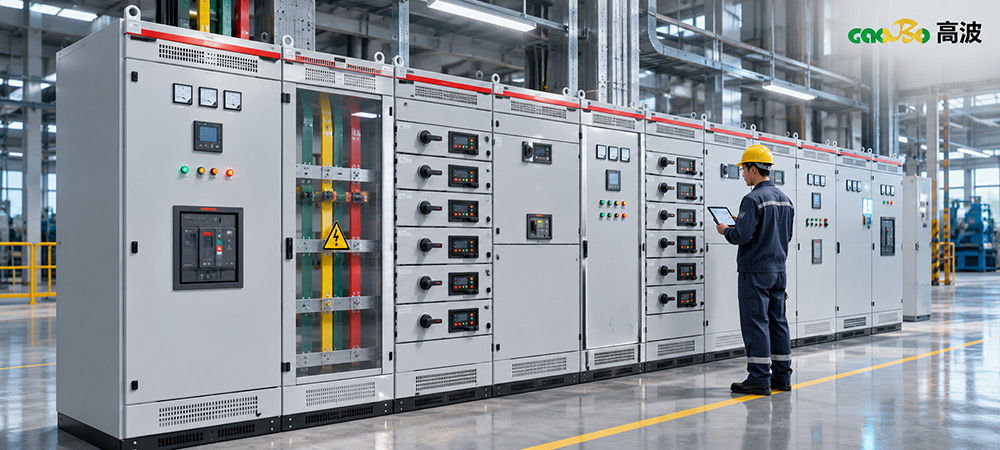
GCS is also a withdrawable low-voltage switchgear system, but it is generally designed with a more standardized modular structure.
Its drawer units are compact and arranged to improve installation density.
GCS is suitable for applications where many feeders must be installed in a limited cabinet area.
Typical applications include:
Industrial plants
Power stations
Commercial buildings
Petrochemical facilities
Mining projects
Utility distribution systems
Compared with fixed GGD cabinets, GCS provides greater modularity and easier circuit replacement.
Compared with GCK, GCS may offer higher functional-unit density depending on cabinet design and project configuration.
MNS is a highly modular low-voltage switchgear platform widely used in demanding industrial projects.
It typically separates the cabinet into different functional zones, such as:
Busbar compartment
Functional unit compartment
Cable compartment
This separation improves maintenance organization and operational safety.
MNS systems can be used for both power distribution and motor-control applications.
Common uses include:
Large industrial plants
Data centers
Process industries
Infrastructure projects
Mining facilities
Automated production systems
MNS is often selected when projects require high modularity, flexible expansion, internal separation, and more advanced monitoring or communication functions.
The biggest difference between these four systems is cabinet structure.
GGD is primarily fixed-type.
GCK, GCS, and MNS are generally withdrawable or modular systems.
This difference affects maintenance and expansion.
With fixed switchgear, components remain permanently installed in the cabinet. Maintenance may require a longer shutdown depending on the circuit.
With withdrawable switchgear, individual functional units can be removed more easily, helping maintenance teams replace or service circuits faster.
For projects where downtime must be minimized, GCK, GCS, or MNS may be more suitable.
A drawer-type feeder can often be isolated and removed without affecting the entire cabinet lineup.
GGD remains a practical choice for simpler distribution systems where frequent feeder replacement is not necessary.
This is why many factories use withdrawable systems for motor-control applications but still use fixed cabinets for general distribution.
Another important factor is the number of circuits that can be installed in each cabinet.
GCS and MNS often provide higher functional-unit density because of their modular design.
This can reduce the total number of cabinets required for projects with many outgoing feeders.
For electrical rooms with limited space, installation density may become an important consideration.
GGD usually offers the lowest initial investment because of its simpler structure.
GCK and GCS are more complex due to the withdrawable drawer mechanism.
MNS may require a higher investment because of its modular structure, separation design, and flexible configuration.
However, buyers should consider lifecycle cost rather than equipment price alone.
For critical facilities, the ability to perform faster maintenance and future expansion may justify a higher initial investment.
The correct choice depends on the project.
Choose GGD when:
Budget control is important
The distribution system is relatively simple
Fixed feeders are acceptable
Maintenance requirements are straightforward
Choose GCK when:
Motor control is important
Withdrawable feeders are needed
Industrial maintenance flexibility is required
Choose GCS when:
High feeder density is needed
Modular expansion is important
Electrical room space is limited
Choose MNS when:
The project requires advanced modularity
Internal separation is important
High reliability is required
Future expansion and monitoring are priorities
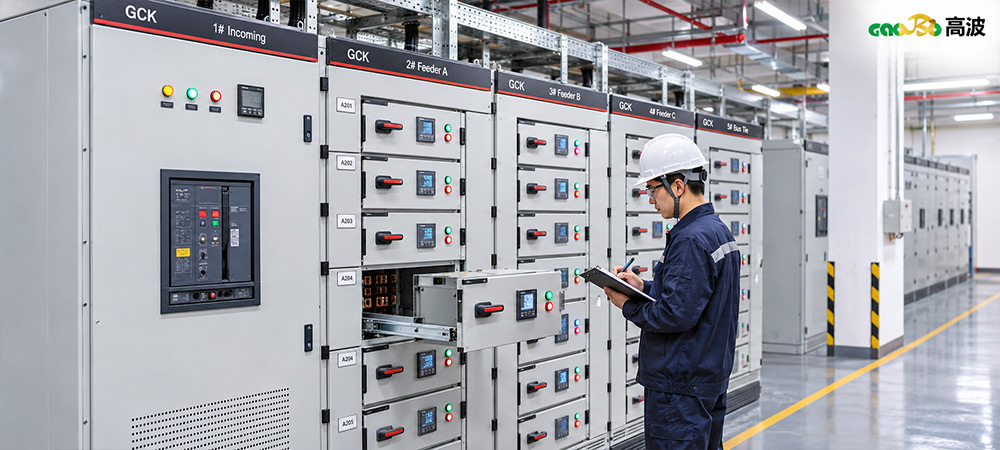
GAOBO SWITCHGEAR MANUFACTURER can manufacture GGD, GCK, GCS, MNS, MCC, ATS, and customized low-voltage switchgear according to customer requirements.
Customization can include:
Rated voltage and current
Busbar capacity
Cabinet dimensions
Breaker brands
Protection devices
Metering
PLC interfaces
Communication
IP protection level
Cable entry
Internal separation
Cabinet labeling
Customers can provide single-line diagrams, load schedules, feeder lists, and preferred component brands for engineering review before production.
GCK, GCS, MNS, and GGD all serve low-voltage power distribution applications, but they are designed for different project needs.
GGD is simple and cost-effective. GCK provides flexible drawer-type motor and feeder control. GCS focuses on modularity and feeder density, while MNS is well suited to more demanding projects requiring advanced modular structure and internal separation.
GAOBO SWITCHGEAR MANUFACTURER provides customized low-voltage switchgear solutions to help industrial and commercial customers select the most suitable cabinet type according to technical, operational, and budget requirements.
GGD is mainly fixed-type switchgear, while GCK uses withdrawable drawer units. GCK offers greater flexibility for maintenance, feeder replacement, and motor-control applications.
Both are withdrawable systems. GCK is widely used for power distribution and motor control, while GCS generally emphasizes standardized modular design and higher feeder density.
Not necessarily. MNS offers strong modularity and internal separation, but the best choice depends on project requirements, maintenance strategy, cabinet space, budget, and future expansion.
GGD is usually the most economical option for simple fixed distribution. GCK, GCS, and MNS generally require higher initial investment but can provide better maintenance flexibility and expansion capability.
Yes. GAOBO SWITCHGEAR MANUFACTURER can customize these low-voltage switchgear systems according to single-line diagrams, rated current, feeder quantity, busbar capacity, component brands, cabinet dimensions, monitoring, and communication requirements.